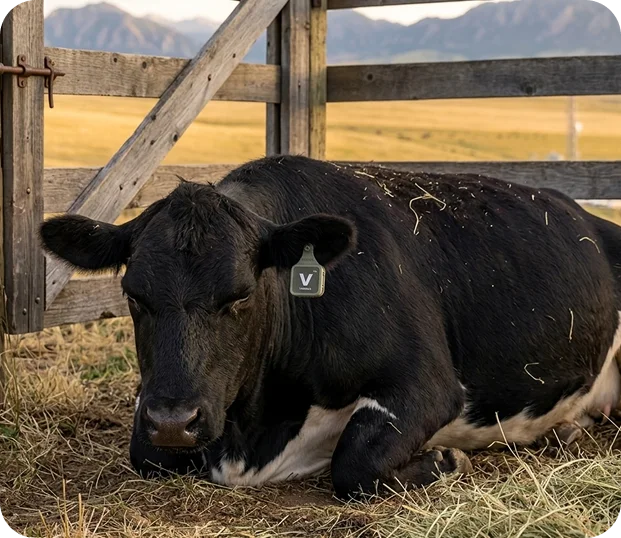
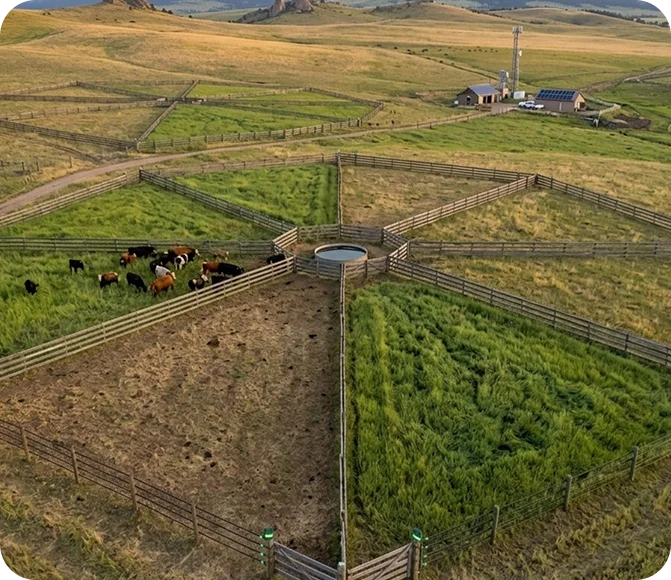
Smarter herding for the modern beef and dairy operation.
Predator zones, flock dispersal mapping, terrain-aware grazing — even where cellular has never reached. The first virtual fence system engineered ground-up for sheep, not adapted from cattle.
Replace the daily labour of moving temporary fence, checking paddock perimeters, and chasing wandering cattle. Across our customer base, a 1,000-head operation typically saves the equivalent of one full-time ranch hand within the first year.
Pasture flexibility opens up
Pasture flexibility opens up Reshape paddocks in seconds, schedule rotations in advance, fence around features that physical posts can’t reach. Move the herd through grazing patterns that were operationally impossible with permanent fence.
Herd health surfaces earlier
Inertial sensors flag changes in animal activity before they’re visible to the eye. Lameness, mastitis, calving difficulty, and heat cycles all generate alerts — typically 12-48 hours ahead of human observation.
Infrastructure costs end
No new permanent fence. No replacement of old fence. No fence-line maintenance during the working life of the system. Most operations recover what they would have spent on 40+ km of fence within 5 years.
✦ DAY 1 · DAY 30 · DAY 90
What the first quarter actually looks like.
Day 1 — Installation Collars fit in an afternoon.
A 1,000-head mob is collared in 4-6 hours with three people working. Training begins immediately — animals encounter the audio cue within hours of fitting.
Day 30 — Training complete, operations changing Herd has settled.
The audio cue alone is now sufficient for over 90% of animals at most boundaries. Operators have drawn their first season’s paddock rotation. Labour spent on fence work has dropped by 60-80%.
Day 90 — Full operational mode Rotation playbooks templated.
Health flag patterns familiar. The dashboard becomes the daily check-in instead of the truck windshield. Operators are typically running paddock rotations 2-4x more frequently than they were before.
✦ WHAT THE SYSTEM DOES
Five capabilities specific to cattle operations.
Heat detection
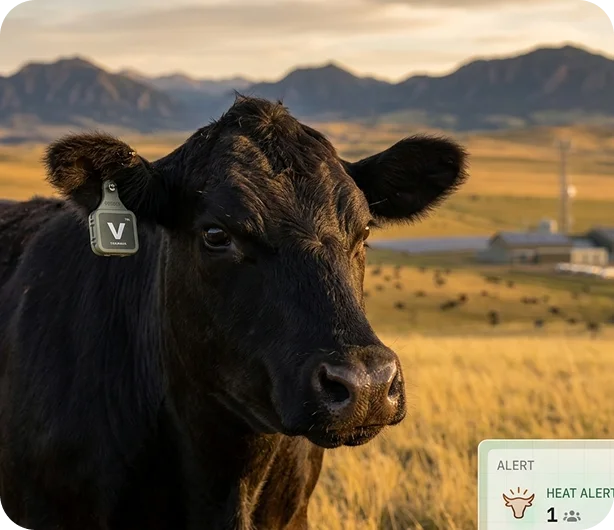
The inertial sensor tracks mounting behaviour and activity spikes characteristic of estrus. Operators receive a notification with timing recommendations for AI or natural service. Median accuracy across the customer base: 91% true positive rate, 4% false positive rate.
Calving alerts
Significant changes in cow posture, isolation behaviour, and activity in the hours before calving trigger an alert — typically 4-8 hours before visible signs. Operators can intervene early in difficult births that would otherwise be discovered too late.
Rotational grazing automation
chedule the season’s paddock rotation in the platform once. The system advances the boundaries automatically on the scheduled day, at the scheduled time. The herd moves itself onto fresh ground without an operator opening a gate.
Tell us about your operation. We'll show you the rest.
A 30-minute call with someone who has actually walked a farm. No slide deck — we’ll open the platform on your block.