Predator zones, flock dispersal mapping, terrain-aware grazing — even where cellular has never reached. The first virtual fence system engineered ground-up for sheep, not adapted from cattle.
Predator alerts that the dogs can't be everywhere for
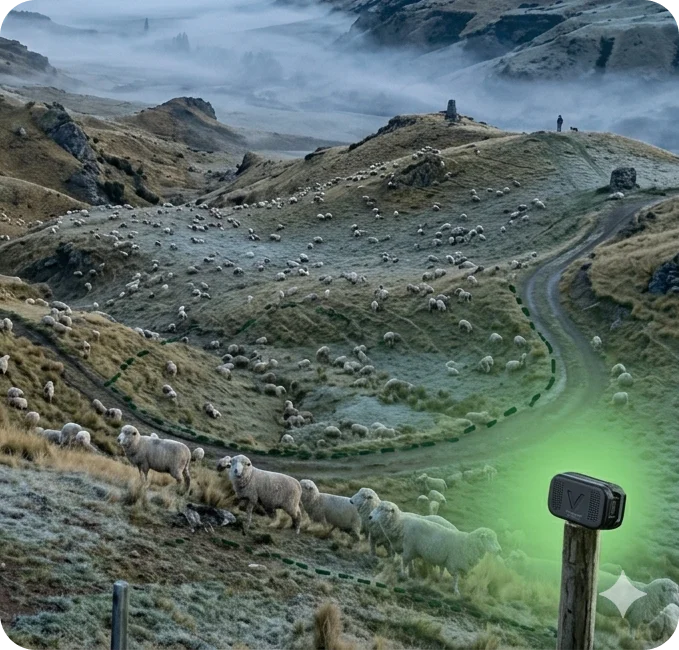
Boundary breaches trigger immediate alerts. Movement patterns characteristic of predator pressure (flock scatter, panic activity) surface within minutes. Working dogs and guardian animals stay where they’re needed; the system covers everywhere else.
Hill terrain is no longer a limit
Multi-constellation GPS holds accuracy across elevation changes that defeat single-constellation systems. Tested in Welsh hills, Scottish Highlands, New Zealand high country, and Norwegian fjord pastures.
Lambing flexibility without temporary fence
Create exclusion zones around lambing paddocks instantly. Move ewes onto fresh ground without disturbing the bond. Track ewe-lamb pairing through movement analytics — confirm which lamb belongs to which ewe.
Mixed grazing becomes one operation
Run sheep and cattle on the same country with separate cells inside shared boundaries. One platform, two species, no double-counting.
✦ DAY 1 · DAY 30 · DAY 90
How It Fits Your Operation
Day 1 — Collars fit in an afternoon, 600-head flock collared in 3-4 hours. Sheep training begins immediately — slightly longer learning curve than cattle (4-5 days median).
Day 30 — Flock has settled into the new boundaries. First lambing inside the system underway if seasonally timed. Operators have drawn lambing exclusion zones and predator-monitor zones.
Day 90 — Hill rotations running automatically. Predator alerts being received and acted on. Operators report 30-50% reduction in dog/handler time across the working week.
✦ 5 FEATURES
Sheep-Specific Features
01
Lambing alerts
Significant changes in ewe behaviour 12-24 hours before lambing trigger an alert. Operators can be present for difficult births, supplement first-time mothers, and reduce lamb mortality during high-loss windows.
02
Ewe-lamb pairing tracking
Movement analytics identify which lamb consistently follows which ewe — confirming pairing and flagging orphaned lambs early. Critical for operations practicing pasture lambing without constant supervision.
03
Predator zone alerts
Boundary breach + flock scatter + sustained panic activity = automatic alert. Operators receive notifications fast enough to dispatch dogs, drive to the paddock, or trigger guardian animals.
04
Hill-country mapping
Boundaries that follow elevation contours, ridgelines, and natural terrain features. Define paddocks across slopes that physical fencing cannot economically cross.
05
Flock-level analytics
Track flock cohesion, average movement, dispersal patterns over time. Identify pasture quality issues before they cause condition loss. Spot illness moving through the flock before symptoms are visible.
Tell us about your operation. We'll show you the rest.
A 30-minute call with someone who has actually walked a farm. No slide deck — we’ll open the platform on your block.