Built for the operators who measure twice and decide once.
Virtual fencing is no longer the question. The question is whose system will still be standing — and earning — five seasons from now. Here’s how we answer that.
Accuacy
A boundary that holds — to within one and a half metres.
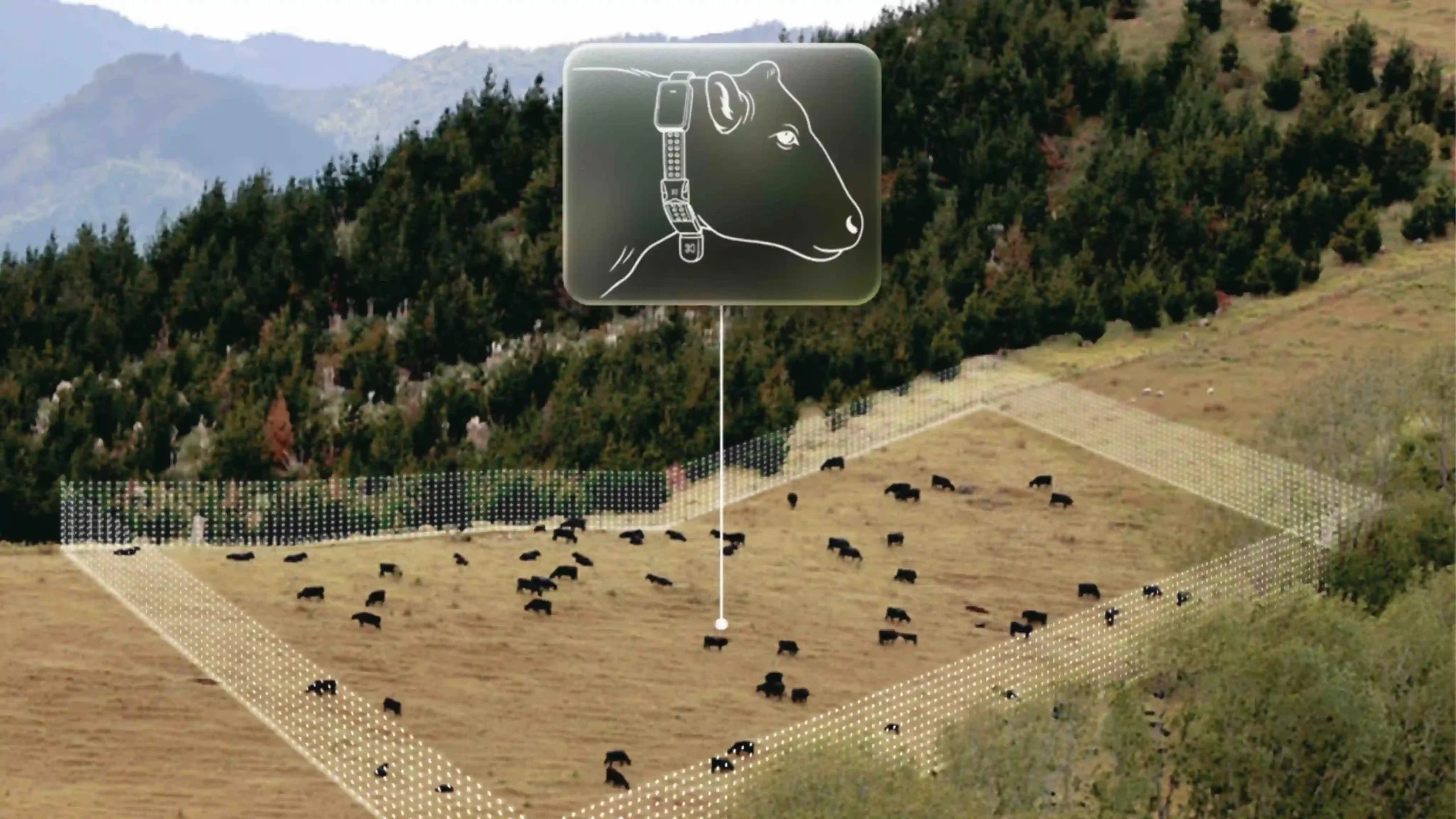
Most virtual fencing systems work to GPS accuracy of four to six metres. That’s the difference between “the cow stayed in the paddock” and “the cow stood in the neighbour’s wheat for an hour before anyone noticed.” We engineered around that gap. Multi-constellation GPS — GPS, GLONASS, Galileo, BeiDou — combined with on-collar inertial sensing brings practical boundary accuracy to within 1.5 metres in open country, and we hold that figure across hill, tree cover, and weather that takes other systems offline. The animal learns a hard line, not a fuzzy zone. The operator gets a measurement they can defend at the boundary.
1.5 m · practical boundary accuracy in open country4 satellite constellations · continuous fix
Welfare
Trained, not shocked. Reviewed by people who would know.
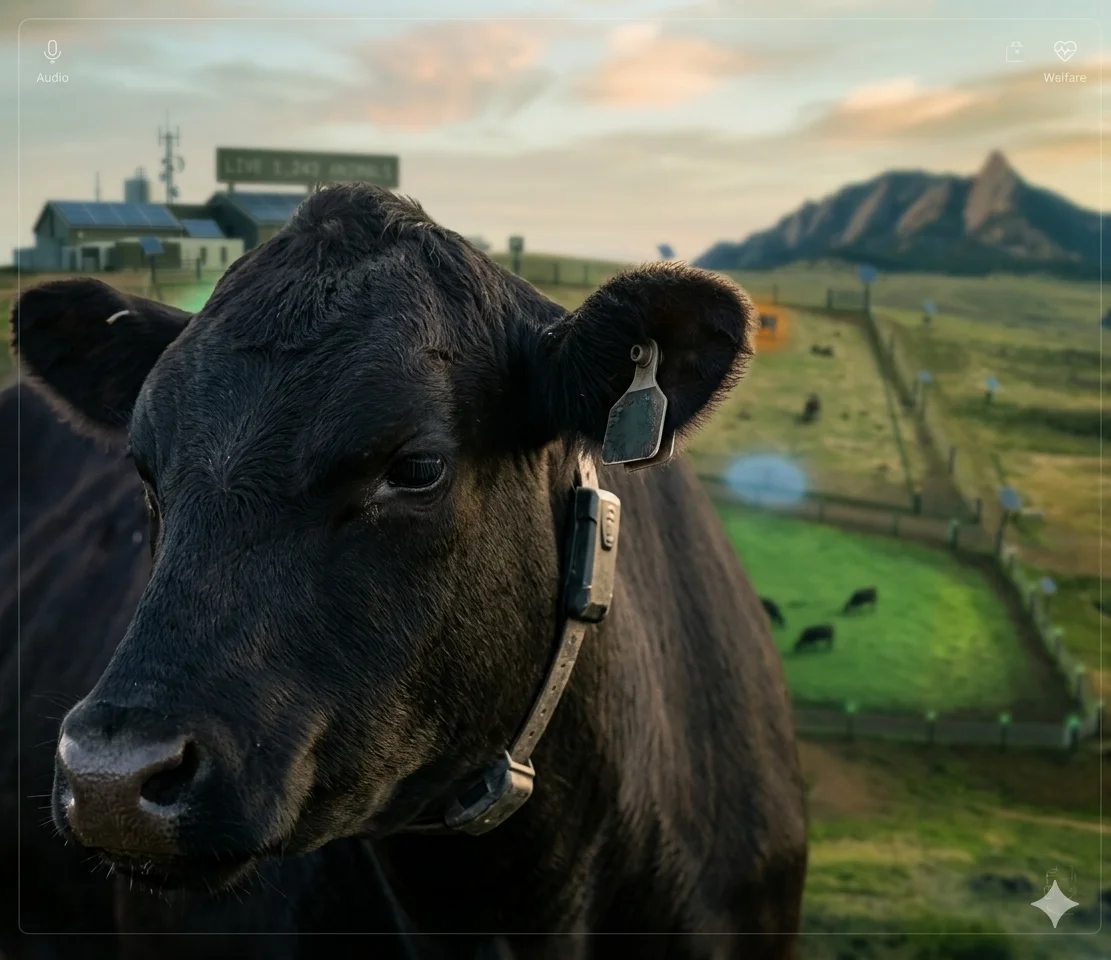
Every collar issues an audio cue first — a tone the animal learns to associate with the boundary within three days. The cue precedes a brief, low-intensity pulse only if the animal continues forward, and over 90% of trained animals never receive the second signal at all. The protocol was reviewed independently by veterinary welfare scientists at three institutions across two continents. Their findings are on the site, with names and credentials, because welfare claims without sources are just marketing. Our position is plain: an animal that learns the boundary cleanly is a calmer animal, a healthier animal, and — over the herd — a more productive animal. Welfare is not a trade-off here. It’s a precondition.
90%+ of animals respond to audio cue alone3 institutions · independent welfare review
Reliability
The fence doesn't drop when the cell tower does.
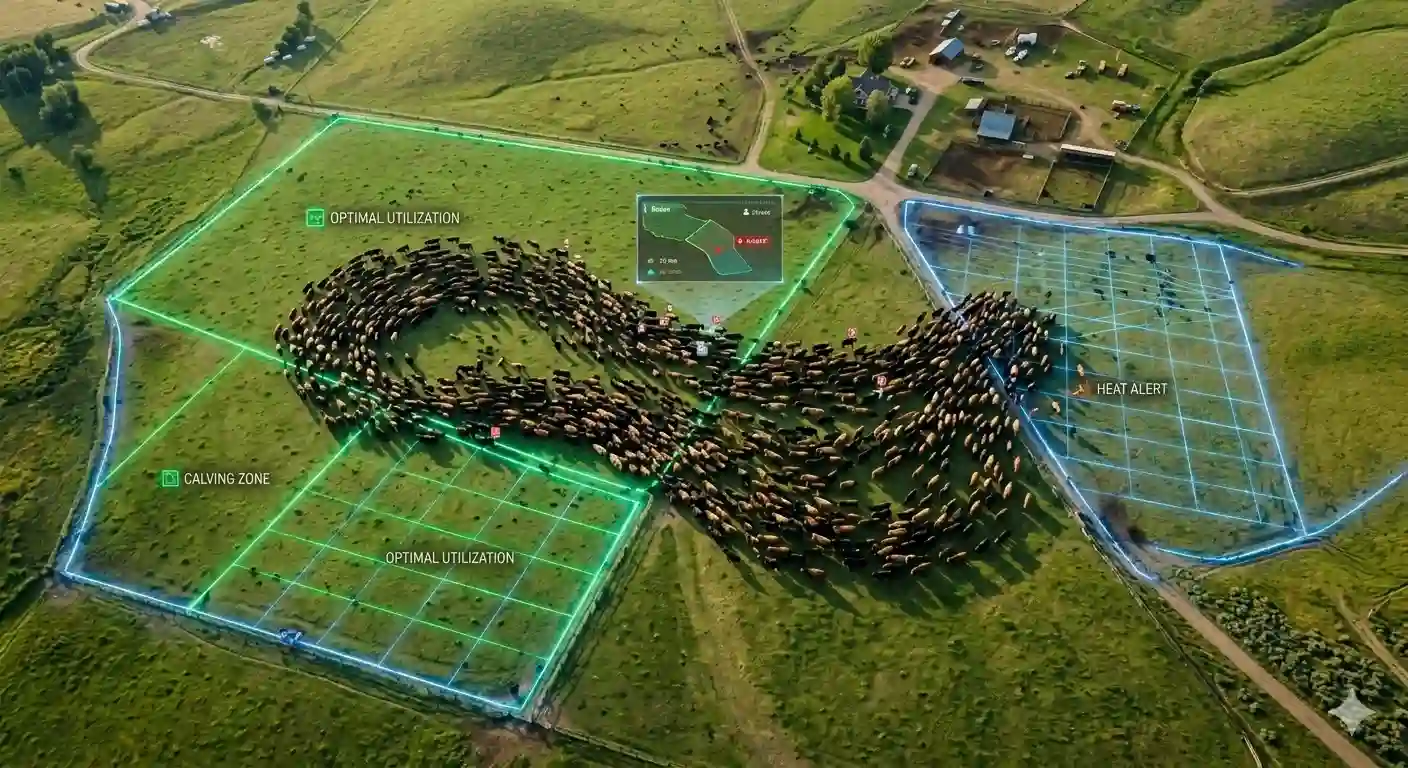
The most common reason ranchers don’t trust virtual fencing isn’t the technology — it’s the connectivity. If your system depends on a single cellular network, your fence has the same dead zones your phone does. We built around that. Every collar carries dual-mode radio — LTE when it’s available, direct-to-satellite when it isn’t — and switches between them automatically without losing the boundary. Where there’s no cellular at all, the system still works. Where there’s no satellite line-of-sight for a short window, the collar caches the boundary locally and keeps containing the animal. The fence stays standing whether the network does or not.
Dual-mode radio · LTE + direct-to-satelliteLocal boundary cache · runs offline up to 72 hours
Accuacy
Built to outlast the animal wearing it.
Hardware is where most virtual fencing companies discover the difference between a prototype and a production tool. A collar that survives an Auckland summer needs to survive a Wyoming winter, a Welsh hillside, and a 600 kg Hereford rolling on it. Ours has logged over 4,000 drop cycles, runs to IP68, operates from minus thirty to plus sixty Celsius, and carries a five-year warranty on every unit — the longest in the category. We chose UV-stable polymer, replaceable strap hardware, and solar charging that never asks the operator to swap a battery. The collar fits the animal once and stays there for the working life of the herd.
5-year warranty · longest in categoryIP68 · −30°C to +60°C operating range4,000+ drop cycles validated
✦ RUN YOUR NUMBERS
Sixty seconds. Your operation. Your payback period.
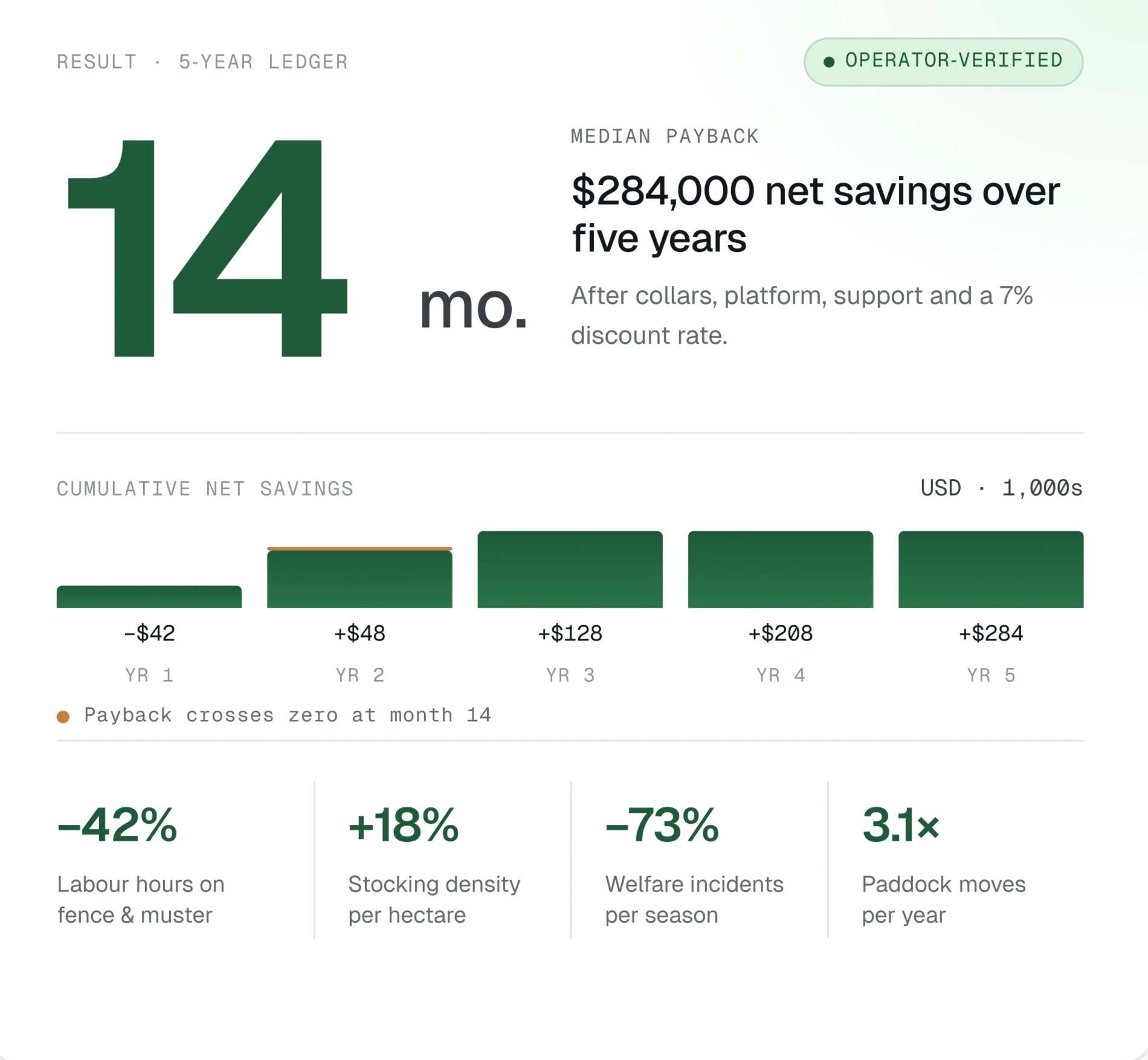
The calculator runs on your herd size, current labour costs, acres managed, and fence maintenance budget. It returns three numbers: estimated annual savings, payback period, and 5-year cumulative gain. The methodology is published — every assumption is sourced and documented.
On a typical 1,000‑head operation, VirtualFence pays itself back in 14 months.
No spreadsheet gymnastics. The model below is the average outcome across 38 working operations after their first full season — fence, labour, mustering and welfare incidents, measured the same way you’d measure them at the kitchen table.
1,000 head · cattle
1,000 head · cattle
1,000 head · cattle
1,000 head · cattle